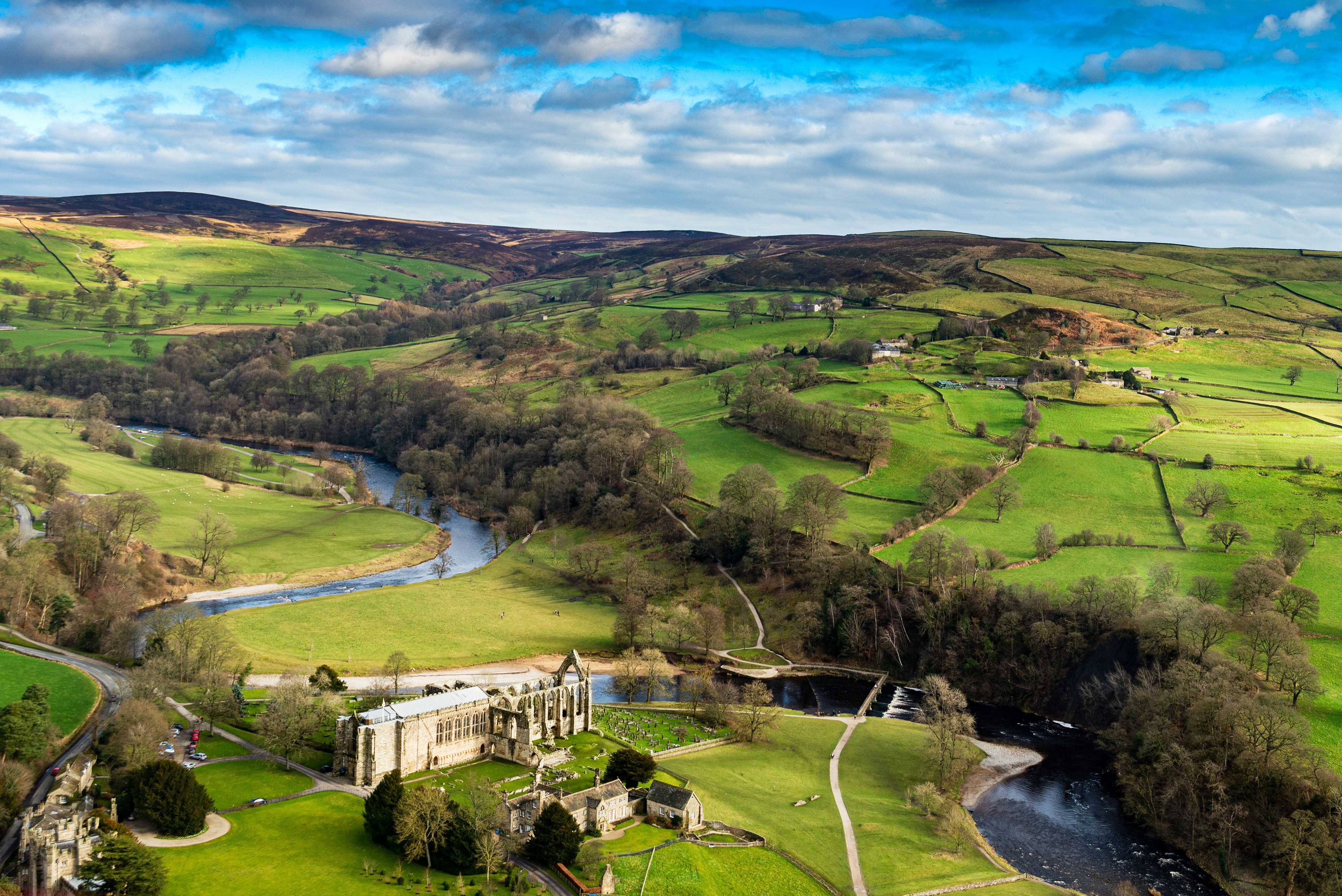
Bolton Abbey
Ancient ruins, riverside paths and the dramatic Strid gorge.
 Duration: 1 hour
£15 per person
A priory, not an abbey
Despite the name, Bolton Abbey was never an abbey. It was a priory, led by a prior rather than an abbot, and the distinction matters to the people who lived here.
The Augustinian canons originally settled at Embsay, five miles west, in 1120. In 1154 Lady Alice de Romille of Skipton Castle granted them land on a bend of the River Wharfe, and they moved. Construction of the priory church began that year and continued, on and off, for the next four centuries.
The Augustinians were not simply monks. They were ordained priests, which meant they supplied clergy to surrounding parishes rather than withdrawing entirely from the world. Bolton grew into one of the largest monastic houses in England, its wealth built on sheep farming and, records show, a lead mine.
Wealth, decline and dissolution
The priory's fortunes rose and fell with the region. Scottish raids in the early fourteenth century caused serious structural damage and the temporary abandonment of the site. The Black Death followed. The canons returned and resumed building.
A new tower was begun in 1520. It was still unfinished when Henry VIII dissolved the priory in 1539. The western half of the nave was preserved so the local parish could continue worshipping, and it does to this day as the Priory Church of St Mary and St Cuthbert. There has been continuous worship on the site since 1154.
The Strid
A short walk upstream, the River Wharfe funnels from a wide river into a channel roughly two metres across. This is the Strid, and it is genuinely dangerous.
The narrowness is deceptive. The river has not shrunk, it has turned on its side, carving deep vertical channels through the rock. Measurements suggest some stretches reach extraordinary depths, with undercut caverns beneath the visible surface. People have died attempting to jump it.
Local tradition holds that Lady Alice de Romille's son drowned here, and that she granted the land to the canons in his memory. Wordsworth wrote about it. Historians are more cautious, noting that Henry I was actively promoting the Augustinian order and his aristocracy were keen to oblige.
Strid Wood and the Valley of Desolation
Strid Wood is one of the finest surviving fragments of ancient oak woodland in Yorkshire, carpeted with bluebells in late spring and home to pied flycatchers, wood warblers, dippers and nuthatches.
The Valley of Desolation earned its name from a violent storm in 1826 that destroyed the trees and vegetation. Replanting since, including eight thousand trees in 1999, has brought the woodland back, and a waterfall makes it worth the detour.
What you will see
We walk from the priory ruins along the Wharfe through Strid Wood to the Strid itself, with the option to continue to the Valley of Desolation. We cover monastic life, the economics of a medieval religious house, the geology that created the Strid, and the ecology of ancient woodland.
Request a Date
Choose a date that suits you and we'll confirm availability by email.
October 2026
What You'll Learn
 Bolton Priory
- The Strid
- Valley of Desolation
- Strid Wood
£15 per person