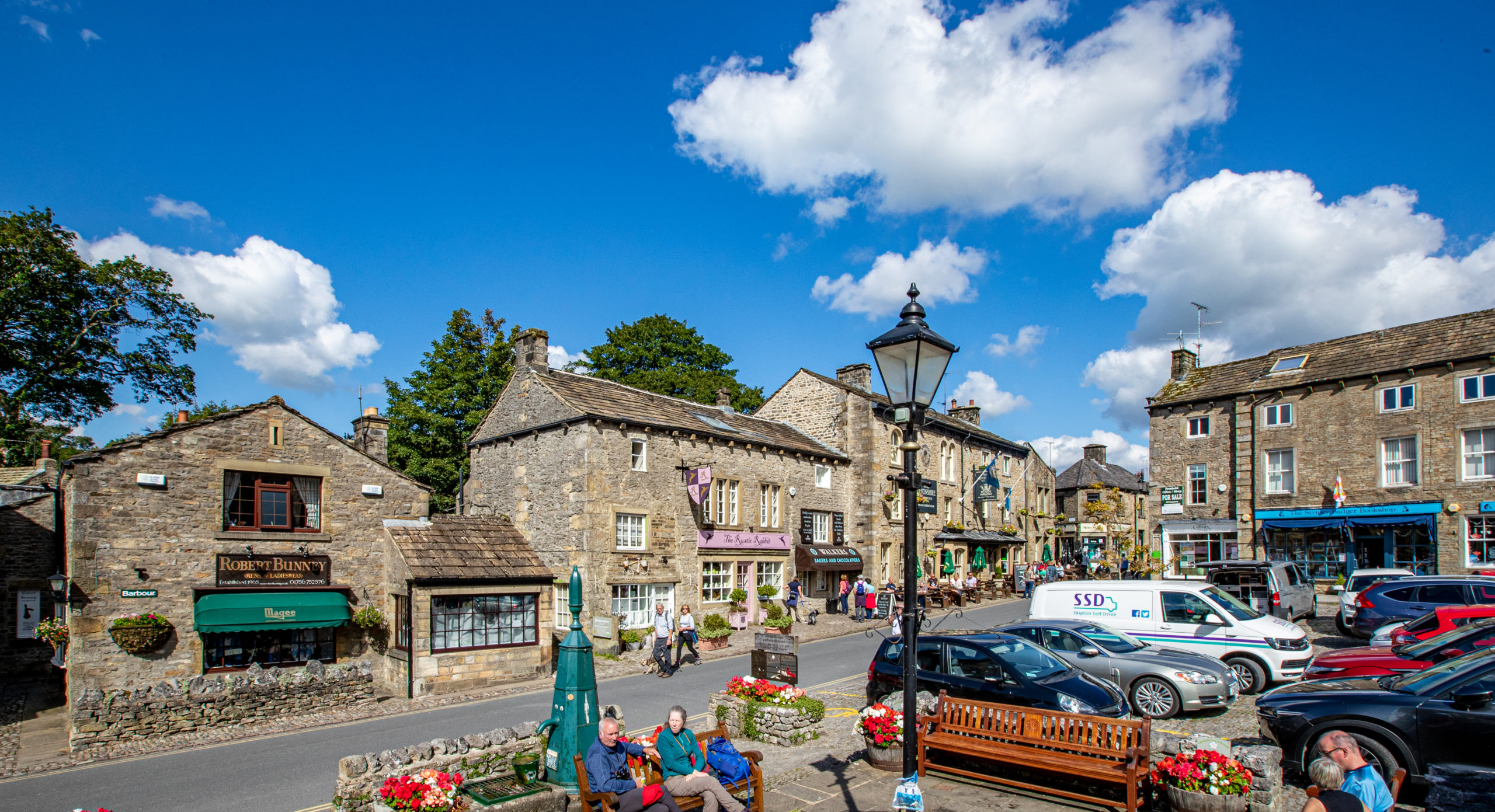
Grassington
Dales heritage, lead mining and timeless village life.
 Duration: 1 hour
£15 per person
An industrial landscape in disguise
Grassington looks like the picture-book Dales village, and it is. But walk onto the moor above it and the ground tells a different story: spoil heaps, shafts, flues, chimneys and the ruins of smelt mills scattered across the hillside.
For centuries this was one of the most productive lead mining landscapes in the north of England. Historic England describes the Grassington workings as the most highly organised and compact mining landscape in the area, and it is scheduled as a monument of national importance.
How lead was won
The ore is galena, a dense grey mineral that feels immediately valuable in the hand. The earliest extraction methods were crude: miners bid for sections of ground called meers along the lead veins, then dug shallow shafts, leaving the doughnut-shaped spoil mounds still visible on the moor. Meer stones marking those allocations survive, a physical record of seventeenth and eighteenth century customary law.
Smelting was equally direct at first. A bale hearth was essentially a bonfire built on a hillside to catch the wind. By 1792 that had been replaced by the Cupola smelt mill with reverberatory furnaces that could burn continuously.
The Duke of Devonshire owned the mineral rights, and the industry's scale shows in the infrastructure. Yarnbury House was built in 1826 for his Mineral Agent. The smelt mill flue running across the moor measures 1.7 kilometres, the longest in the Yorkshire Dales. It was periodically scraped and washed to recover lead deposited from the fume, a job as dangerous and unpleasant as it sounds.
Captain Barratt
From 1818 the mines were reorganised under Captain Barratt, the local agent and engineer. He introduced new ore dressing techniques, invented a forerunner of the mechanical jig, and drove an incline into the workings that brought ponies underground to haul ore. The portal, dated 1828, still stands.
Deep mining brought water problems, and in 1796 work began on one of the longest drainage levels in the Dales, north of Hebden village.
The end and after
Cheap imported lead undercut the market and the high altitude Dales workings became uneconomic. The last lead mine in the Dales closed in 1912.
What remains is a village that grew on lead and stayed for farming. Settlement here goes back a very long way: the Domesday survey records three hundred acres of arable and meadow already under cultivation. The cobbled square, the Folk Museum in a converted lead miner's cottage, and the surrounding field patterns are all readable if you know what you are looking at.
What you will see
We walk the village and its cobbled square, then out towards the mining landscape to look at spoil heaps, shafts and the surviving structures. We cover how lead was mined, dressed and smelted, the customary law that governed the industry, and how Dales farming shaped the fields you walk through.
Request a Date
Choose a date that suits you and we'll confirm availability by email.
October 2026
What You'll Learn
 Lead mining landscape
- The cobbled square
- Dales farming heritage
- Upper Wharfedale
£15 per person