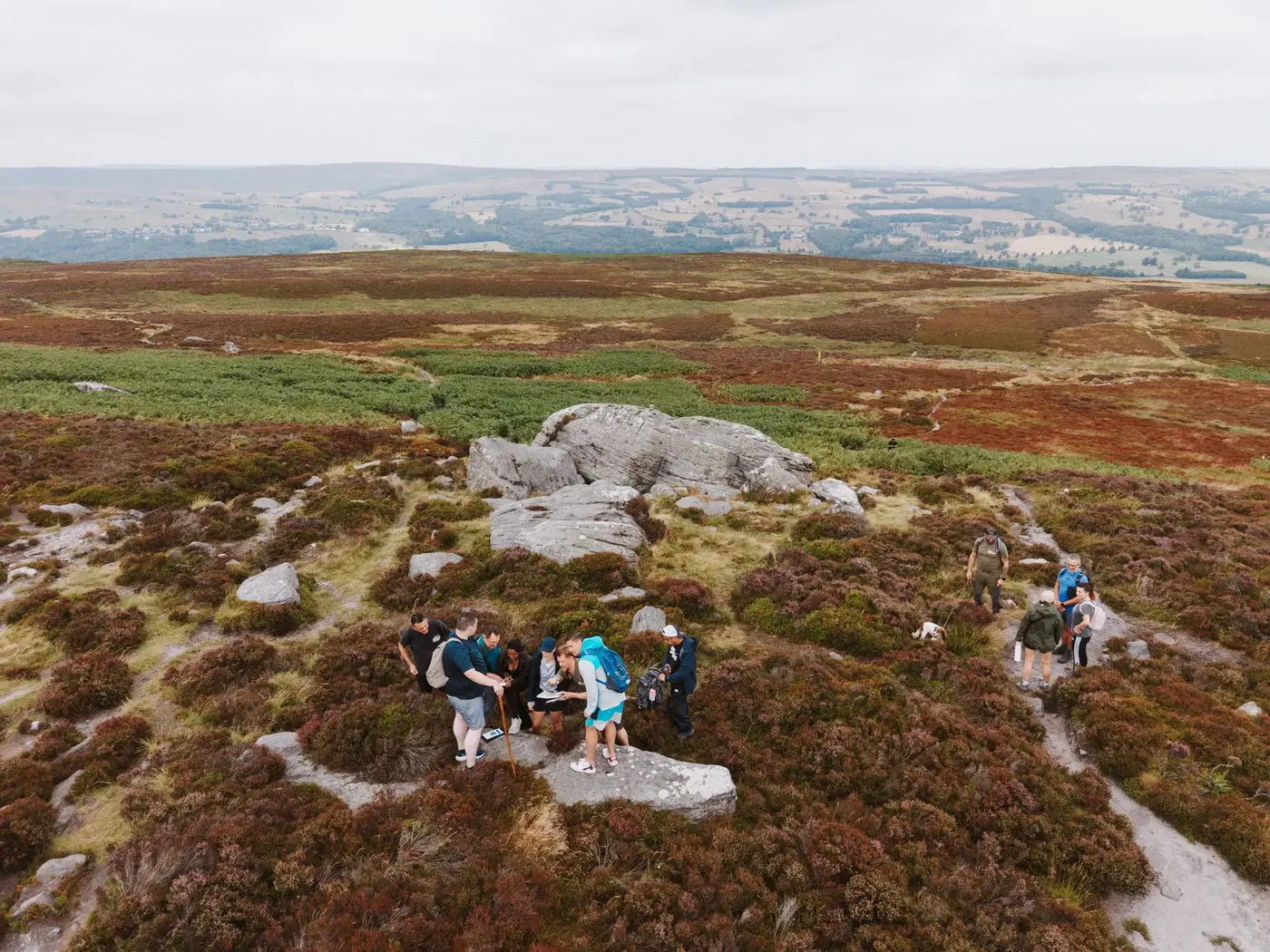
Ilkley Moor
Ancient stones, folklore and the story behind Yorkshire's most famous song.
 Duration: 3 hours
£25 per person
Britain's most mysterious moorland
Ilkley Moor, properly Rombalds Moor, holds one of the most remarkable concentrations of prehistoric rock art in Europe. Over four hundred examples of cup and ring marks are carved into gritstone outcrops across the moor, giving this area the second highest concentration of prehistoric rock art on the continent.
Nobody knows what they mean. The carvings date from the Bronze Age, made by people who lived here from at least 1800 BC. Theories range from territorial markers to astronomical records to ritual symbols, and the honest position is that the evidence does not settle it.
The Twelve Apostles
On Burley Moor stands a stone circle of twelve gritstone uprights arranged in a rough oval, known as the Twelve Apostles. It is around 3,500 years old, placing it firmly in the Bronze Age.
The name is relatively recent. What the builders called it, and what they used it for, are both unknown. Stone circles from this period served overlapping purposes across Britain: astronomical alignment with seasonal events, funerary rites, ancestor veneration and community gatherings. No single explanation fits every site.
The Druids have long been associated with places like this in the popular imagination, and standing among the stones on a misty morning it is not hard to see why. A priestly class who committed nothing to writing, who held their assemblies in sacred groves, and who left behind no record of what they believed. What actually took place on this moor remains one of the genuinely unsolved questions of British prehistory, and that is exactly what makes it worth standing in silence when you arrive.
Giant Rombald
The moor takes its name from folklore. A giant called Rombald was said to live here with his wife. One day she chased him across the valley in a fury. As he fled he stamped on a great rock and split it in two, creating the Cow and the Calf. As she ran she dropped the stones she carried in her skirt, forming the Great Skirtful of Stones, and threw more at him, missing and creating Almscliffe Crag across the valley.
The Cow and Calf themselves are millstone grit, the coarse sandstone that outcrops across the South Pennines and gives the moor its acid soils, its heather and its character.
The song
On Ilkla Moor Baht 'at is Yorkshire's unofficial anthem, sung in broad West Riding dialect. Tradition holds that it originated during a chapel choir outing to the moor in the mid nineteenth century, when a young man was seen courting a girl in the heather having forgotten his hat. His companions composed a darkly comic warning about the consequences.
What you will see
We walk from the Cow and Calf across open moorland, taking in rock art panels, the Twelve Apostles, the summit trig point at 402 metres and views across Wharfedale. We cover moorland ecology, the heather management cycle, the birds you are likely to see, and which plants on the moor are edible.
On this tour
Reviews
It was so much more than just a hike. I learned practical map-reading skills, how to take and use coordinates, and gained a real insight into the nature, history and landscape of the area. The guide was knowledgeable, friendly and made the whole experience really enjoyable, with plenty of interesting facts and stories along the way. A brilliant mix of adventure, learning and enjoying the outdoors.
Julie W
Ryan and his team made us feel very looked after during our day with Hike Yorkshire. I gained a lot of knowledge in navigation during the day and the guys were sharing valuable knowledge throughout the walk. Would definitely recommend!
Joe M
Absolutely top class day out on the hills led by expert guides. Great knowledge of the area helping us hone our winter skills.
James A
Book this tour
Loading available dates...
What You'll Learn
 Bronze Age rock art
- Twelve Apostles stone circle
- The Cow and Calf
- Moorland ecology
£25 per person