Ripon
Cathedral spires, market squares and one of the world's oldest living traditions.
 Duration: 1 hour
£15 per person
St Wilfrid's city
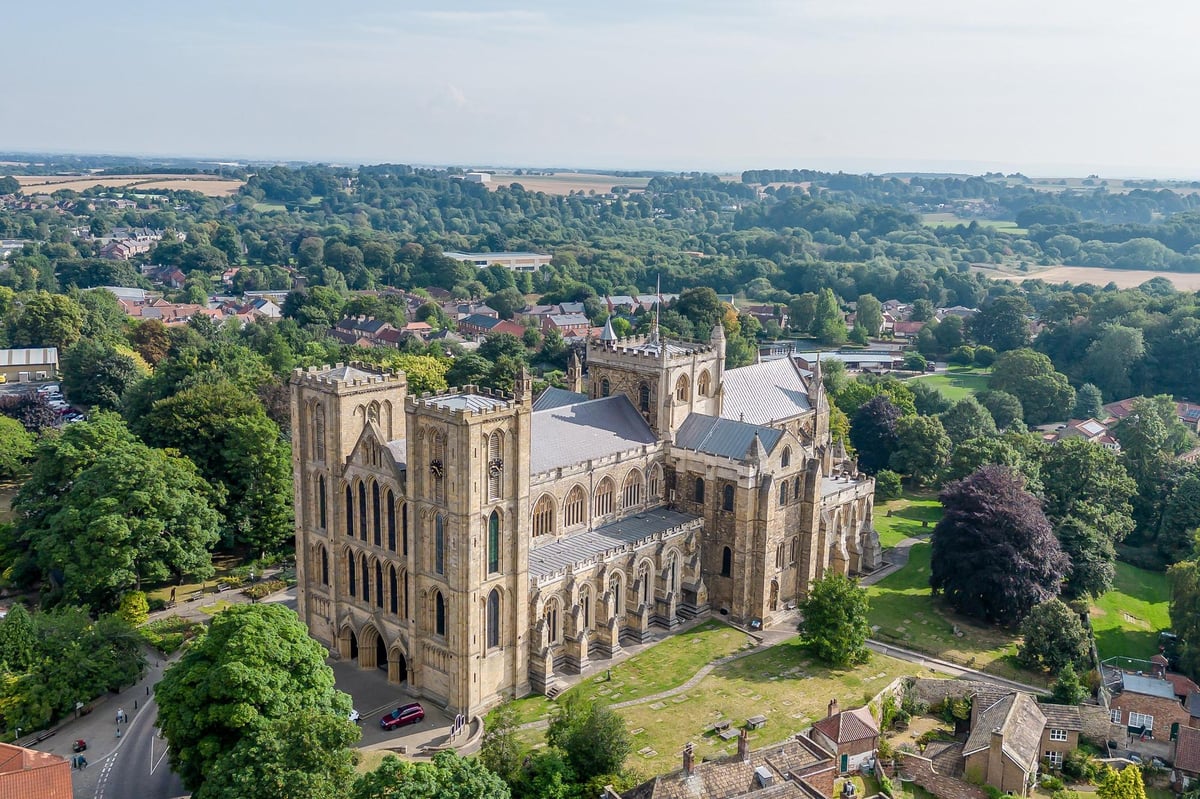
Ripon began as a religious foundation. The first church here was an Anglo-Saxon timber building established by monks from Melrose. In 672 Wilfrid, one of the most influential and combative figures in the early English church, replaced it with a stone church dedicated to St Peter.
Wilfrid did not build it locally. He brought stonemasons, plasterers and glaziers from France and Italy, importing continental building expertise into seventh century Northumbria. Born into an aristocratic Northumbrian family around 634, he joined the monastery at Lindisfarne as a teenager and travelled to Rome three times.
The crypt he built survives beneath the present cathedral. It is one of the oldest intact Anglo-Saxon structures in England, and standing in it is an unusually direct connection to the seventh century.
The Norman conquest went badly for Ripon. The Harrying of the North reduced the town to a few streets around a wrecked church.
The Wakeman
In 886, during the reign of Alfred the Great, Ripon was granted a Charter Horn as a form of legal tenure. The Liberty of Ripon, roughly a ten mile radius from the cathedral, was freed from royal taxes and offered sanctuary.
Out of this came the Wakeman, head of one of the earliest forms of local government in England. His job was to keep order between nine in the evening and dawn. Householders paid him what amounted to early insurance, funded by a levy based on the number of outside doors a property had: fourpence a year for a door facing the street, twopence for one at the back or side. If a house was burgled, the Wakeman could be found negligent and fined.
Each evening he sounded a horn in the Market Square to signal the watch was set.
Eleven hundred years, unbroken
In 1604 James I granted Ripon its first written charter and abolished the office of Wakeman, replacing it with an elected mayor. Hugh Ripley, the last Wakeman, became the first Mayor. His house still stands on the Market Square.
The ceremony did not stop. The new Mayor appointed a Hornblower to continue setting the watch, and it has been performed nightly ever since. Every evening at nine o'clock the horn is sounded at the four corners of the obelisk in the Market Square, then three times before the Mayor to report the watch is set.
It is among the longest continuously observed civic traditions anywhere in the world.
What you will see
We walk the market square with its ninety foot obelisk of 1702, the Wakeman's House, the medieval streets and the cathedral including the Saxon crypt. We cover Wilfrid and the early English church, the Wakeman system and how medieval towns policed themselves, and the survival of the Hornblower ceremony into the present.
Request a Date
Choose a date that suits you and we'll confirm availability by email.
October 2026
What You'll Learn
 Ripon Cathedral
- The Wakeman's House
- The Hornblower ceremony
- Saxon origins
£15 per person