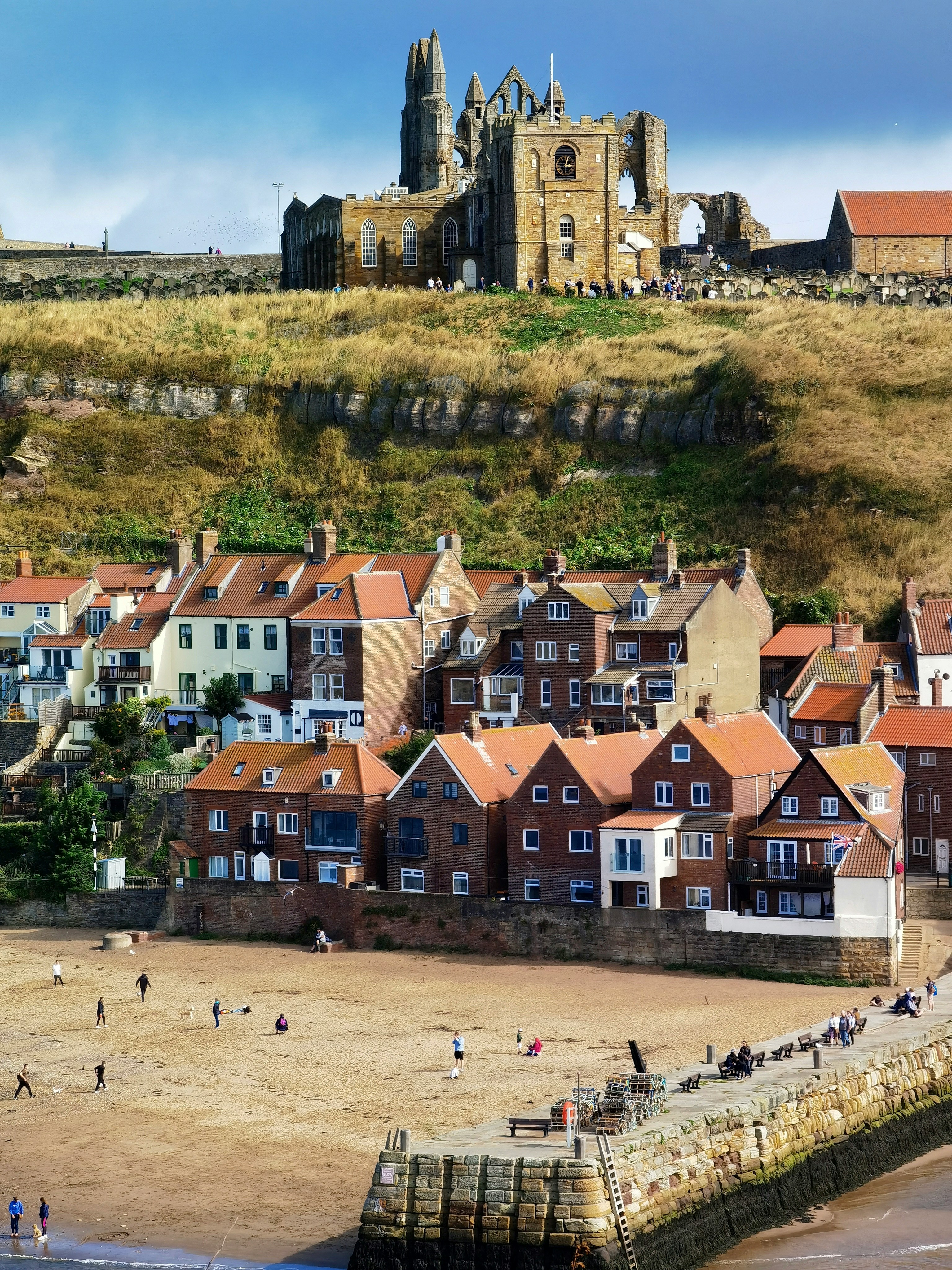
Whitby
Seaside legends, abbey ruins and tales of sailors and storytellers.
 Duration: 1 hour
£15 per person
Where English Christianity was decided
The abbey on the East Cliff was founded in 657 by Hilda, a Northumbrian noblewoman who became one of the most influential figures in the early English church. The settlement was then called Streoneshalh.
In 664 the abbey hosted the Synod of Whitby, a gathering that settled a genuine crisis in English Christianity. The Roman and Irish traditions calculated the date of Easter differently, which meant the king could be celebrating while the queen was still fasting. The synod came down in favour of Roman practice, and in doing so set the direction of the English church for centuries.
The abbey also produced Caedmon, a cowherd who according to Bede received the gift of song in a dream and became the earliest English poet whose name we know.
Norse Whitby
The name Whitby is Norse, reflecting Scandinavian settlement along this coast. The Danish raids of the ninth century destroyed the original monastery, and the site lay abandoned until the Normans refounded it as a Benedictine house after the Conquest.
The ruins standing today are largely thirteenth century, and they are among the most dramatic in England, silhouetted on the clifftop above the harbour.
A working port
Whitby's wealth came from the sea. It was a major whaling port in the eighteenth and nineteenth centuries, and a shipbuilding centre of real significance. The ships James Cook sailed on his voyages of exploration were Whitby-built colliers, chosen for their strength and shallow draught.
The town also had jet, a black fossilised wood found in the local cliffs, carved into jewellery for centuries. When Queen Victoria adopted jet mourning jewellery after Albert's death, Whitby's jet industry boomed.
Dracula
Bram Stoker visited Whitby in 1890 and the town lodged itself in his imagination. In the novel, the ship Demeter runs aground in Whitby harbour and Dracula comes ashore in the form of a black dog, bounding up the steps to the churchyard.
Those steps are real. There are 199 of them, climbing from the old town to St Mary's Church and the abbey beyond, and they were built so coffins could be carried up to the graveyard.
What you will see
We walk the old town and harbour, cross to the East Cliff and climb the 199 Steps to St Mary's Church and the abbey ruins. We cover the Synod of Whitby, Caedmon, the whaling and jet industries, the Cook connection and the Dracula locations, with views along the coast throughout.
Request a Date
Choose a date that suits you and we'll confirm availability by email.
October 2026
What You'll Learn
 Whitby Abbey
- The 199 Steps
- Maritime heritage
- Dracula connections
£15 per person